
FIXTURE CLAMPING DEVICES
VektorFlo power clamps provide the “helping hands” to present more parts to the machine spindle with less effort, more consistently and at a cost only modestly more than manual fixtures. Use VektorFlo to increase your productivity. Our fixture clamping devices help users across a wide range of industries maintain the precision, repeatability and efficiency their applications demand. Explore our pneumatic link clamps for fast automated actuation and our directional control valves for hydraulic circuit control.
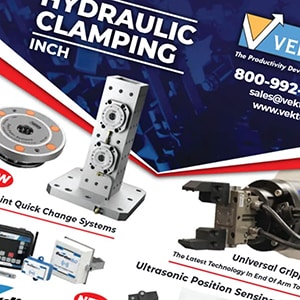
INCH PRODUCTS

METRIC PRODUCTS
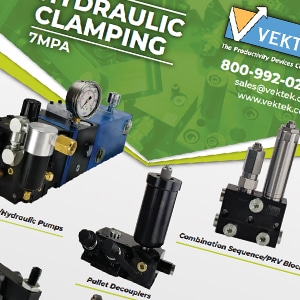
LOW PRESSURE PRODUCTS
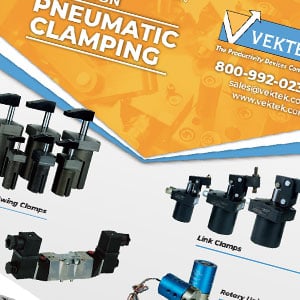
PNEUMATIC PRODUCTS
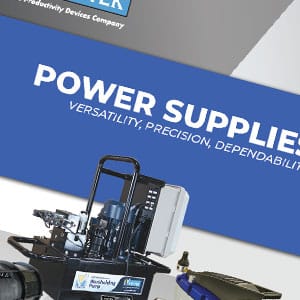
POWER SUPPLIES

SELF-CENTERING VISES
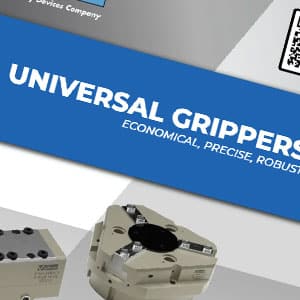
END OF ARM TOOLING PRODUCTS

ZERO-POINT SYSTEMS
The Role of Fixture Clamping in Precision Workholding
A fixture clamp secures a workpiece in a precise, repeatable position during machining, assembly or inspection processes. Unlike general-purpose vises or manual clamps, a fixture clamping device is integrated into purpose-built workholding systems designed for specific part geometries and machining requirements. These systems apply controlled clamping forces through hydraulic, pneumatic or mechanical actuation to stabilize a workpiece against cutting forces and vibration.
The role of fixture clamping in precision workholding goes far beyond simply holding a part in place. Effective clamping systems help maintain part position and orientation throughout the machining cycle, supporting the consistent dimensional accuracy that manufacturers require. This stability promotes enhanced surface finish quality while reducing tool wear and minimizing the risk of scrap and rework.
Benefits of VektorFlo Workholding Clamps
VektorFlo workholding clamps provide many operational advantages for precision manufacturing, including:
- Increased throughput: Hydraulic and pneumatic actuation reduce manual clamping time during loading and unloading, helping maximize overall machine efficiency.
- Repeatable part positioning: Controlled clamping force and precise workpiece location help minimize part-to-part variance while supporting dimensional consistency for high-volume production.
- Enhanced operator safety: Automated clamping systems decrease the risk of part ejection, creating safer working conditions.
- Improved machine performance: Rigid clamping helps reduce chatter and vibration during cutting operations, resulting in better surface finish and extended tool life.
How to Choose the Right CNC Fixture Clamps
The selection of any single brand of hydraulic clamp, as with any important decision, comes from an informed and intelligent point of view. Make your choice based on the needs of your specific application.
- Evaluate required clamping force: Hydraulic clamps deliver high clamping forces for heavy cuts on demanding materials, while pneumatic systems offer faster actuation for lighter-duty applications and automated cells.
- Consider available space and clearance: Low-profile swing clamps fit space-constrained setups, while adjustable vertical supports provide upward pressure for thin-walled or irregularly shaped parts.
- Match clamp type to part geometry and material: Hold-down clamps apply direct downward force for rigid workpieces, while spring-loaded fixture clamps provide consistent pressure for more delicate components.
- Account for automation requirements: Pneumatic or hydraulic actuation integrates with automated control systems for fast open-close cycles and repeatable positioning.
Common Applications for Industrial Clamps
CNC fixture clamps provide the stability required for demanding manufacturing operations like:
- CNC machining: Multiaxis operations require rigid workholding to maintain part position during complex tool paths and varying cutting forces.
- Milling and drilling operations: High spindle speeds and aggressive feed rates demand secure clamping to prevent part movement.
- Automated manufacturing cells: Robotic work cells rely on pneumatic and hydraulic actuation for consistent cycle times and minimal operator intervention.
To power hydraulic fixtures, explore our power supplies, or choose our low pressure work support and clamp systems for lighter-duty fixtures.
FAQs
Browse our most Frequently asked questions around our hydraulic workholding lines and if you have an issue that isn’t covered here, reach out to our product support team below.
What's the difference between hydraulic, pneumatic and mechanical fixture clamps?
Hydraulic clamps use pressurized fluid to generate high clamping forces in compact packages, making them ideal for heavy machining operations. Pneumatic clamps use compressed air for faster actuation and automated systems, while mechanical clamps rely on manual mechanisms for applications requiring continuous holding force without active pressure.
How do I calculate the required clamping force for my application?
Required clamping force depends on cutting forces, workpiece geometry, material properties and fixture design. Vektek’s engineers can help determine appropriate force requirements and recommend clamping solutions for your specific machining conditions.
Can Vektek provide clamps for a fully automated CNC cell?
Yes. Vektek specializes in workholding solutions for automated manufacturing environments. Our engineers can provide technical support for integrating pneumatic and hydraulic clamping systems into robotic workflows and automated production lines.
Find the Right Fixture Clamping Solution Today
Before making any decision, we ask that you take time to compare product quality, availability, technical support and service before and after the sale. When you do, you discover VektorFlo® “head and shoulders” above the rest! This is why Vektek is America’s leading manufacturer of power workholding products.
Browse our fixture clamping options to find a design that meets your operational requirements. You can also contact us online with questions or to request additional information.
You have questions? WE HAVE ANSWERS!
Use the contact button below to be connected with one of our team of experts.