
Clamping Force
The clamping force varies according to the clamp arm length. The clamping force F can be calculated using the following formula.
Clamping force calculation formula:
- F = F cyl x ( B ÷ C ) x E
- F = Clamping force (lb)
- F cyl = Cylinder force (lb)
- F cyl = P x A
- P = Operating Pressure (psi)
- A = Cylinder Area (sq in) (See table below)
- B, C = Clamp Lever Length (in) (See Table below)
- E = Output Efficiency (Approx. 0.9 for standard length and 1.5 for extended length lever


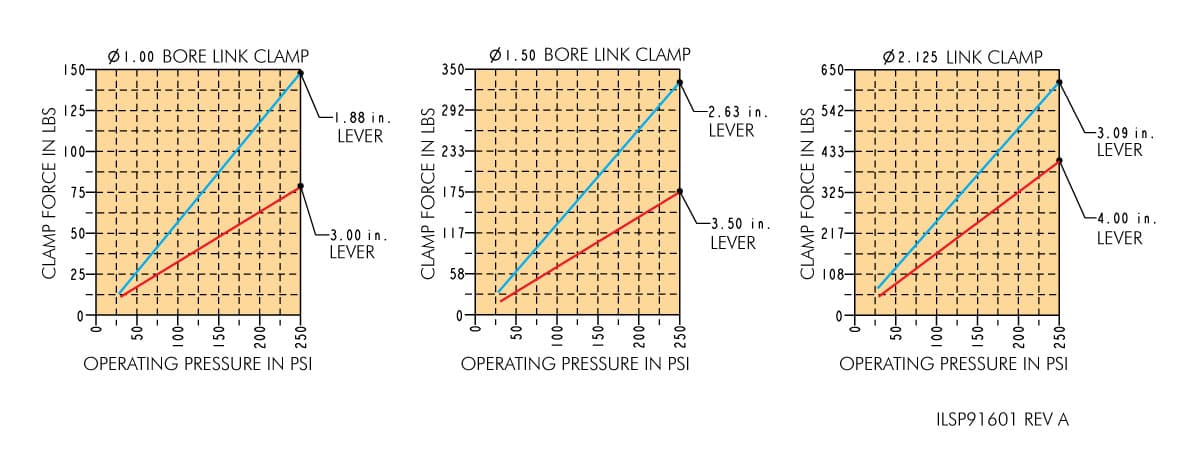
Operating Curves
Link Clamp Lever Output Curves
Modifications to levers that result in clamp ratios below that of the standard lever are not in the safe operating zone for the corresponding link clamp and could result in premature failure.
FAQs
Browse our most frequently asked questions and if you have an issue that isn’t covered here, reach out to our product support team below.
Why do I need to know my shop air pressure when planning my system?
Your shop air pressure (in psig, pounds per square inch gauge) will help you determine the size clamp necessary to perform the work that you want to accomplish. The pressure should be measured with an accurate gauge at the point nearest the work area and with normal demand on your system. Pressure measured at the compressor is not valid because continuously pressurized gauges are notoriously inaccurate and there is measurable pressure drop over any extended length of pipe, hose or tubing. Demand on your system will result in fluctuations between just a few percent and as much as 50% for an undersized compressor. You will need to know the minimum air pressure supplied continuously to avoid having parts come unclamped or clamps not operating properly.
Is it necessary to check our clamping system for air leaks?
Yes. Since air used in a pneumatic system is a compressible medium, leakage will dramatically affect clamping loads. Therefore, circuits should be checked with a suitable leak detection solution such as SNOOP® or equivalent.*
*SNOOP® is a registered trademark of Swagelok®.
We shut the air supply down to our clamps once they are in position. Sometimes we notice that they are sticking. Could this be the cause?
Yes, you should avoid deadheading clamp circuits. Keep the valve engaged and air flow to the clamps during the entire clamping cycle.
After clamping, my swing clamps are moving. I cannot detect a leak. Why do I have this movement?
Where have you set your minimum operating pressure? When establishing operating pressure for the system, remember that 30 psig is the minimum and must be maintained during cycling. If you set your regulator to 30 psig and then open the valve and the pressure drops to 20 psig during clamping, you need to increase pressure until 30 psig is maintained during the entire clamping cycle. This will prevent cycle problems like the one you describe.
We need to regulate the speed of the clamping. How is this best done?
If component speed is an issue, always regulate the speed from the opposite side of the piston where the pressure is being applied. In other words, if the return stroke is to be controlled, use the exhaust flow from the extend stroke to regulate the speed. This will give superior control and avoid problems with devices sticking.
Is it necessary to use an intensifier?
No. You do not need an air intensifier to make your clamps work. Air intensifiers will allow smaller physical size clamps to do more work. For example, referring to the Product Clamping Forces chart, clamp P1-5110-00. will generate 165 lbs. clamp force at 250 psig, P1-5240-00. will generate 165 lbs. at 60 psig, but is over twice the bore diameter, jumps from 1 7/8″ to 3 1/4 in body thread and from about 5 1/2″ to over 8″ in height. If smaller is better, higher-pressure makes swing clamps smaller.
Can we restrict our swing clamps to rotate less than 90 degrees, or make them rotate further than 90 degrees?
Restricting the swing to less than 90 degrees is reasonably simple. We can provide 45 degrees and 60 degrees for a small up-charge. Precise swing angles and those greater than 90 degrees are possible as specials and will be costly. Contact your Vektek representative to discuss special swing clamp needs.
Can we modify the standard arm that is included with the swing clamp?
Yes, you may modify the standard arm; it is machineable and weldable steel. In order to remove it, please be sure to follow arm removal and re-installation instructions. Remember that larger arms are larger mass and reduced rotational speed is recommended to avoid damage to the rotational cam track.
Why would we use a sensor switch with our swing clamps?
You may choose to use a position sensor to detect the location of the swing clamp plunger. The sensors can confirm clamp in position, clamp in unclamp position or clamp in neither clamp or unclamp position.
You have questions? WE HAVE ANSWERS!
Use the contact button below to be connected with one of our team of experts.