
Swing clamps help manufacturers secure parts while keeping the work area clear for loading, machining, inspection and unloading. Instead of clamping straight down from a fixed position, the arm swings away from the workpiece, then rotates into position and clamps with controlled force. That motion makes them valuable in precision fixtures where access, repeatability and cycle time matter.
For fixture builders looking to move beyond manual toggle clamps, Vektek swing clamp systems offer a practical upgrade path. TuffCam™ is built for heavy-duty hydraulic workholding, while VersaCam™ gives buyers flexible hydraulic and pneumatic options for a range of fixture layouts.
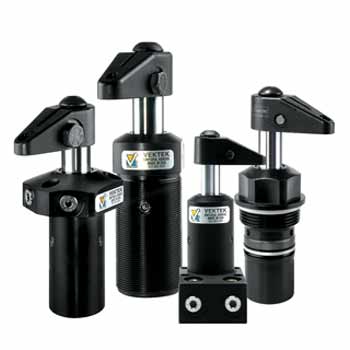
TuffCam™ Swing Clamps
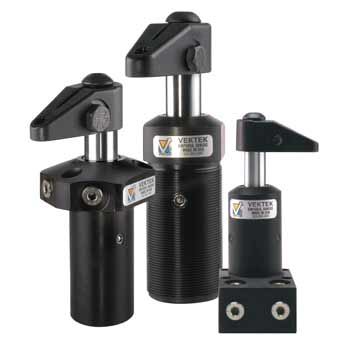
VersaCam™ Swing Clamps
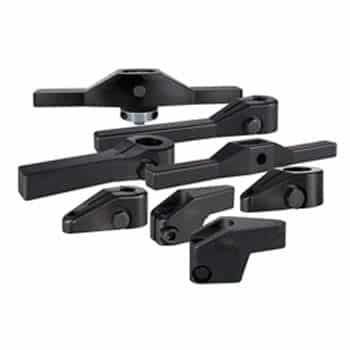
Swing Clamp Arms
Key Benefits for Repeatable Clamping and Dependable Performance
Vektek swing clamps are designed to help reduce setup time, improve part-to-part consistency and support faster fixture operation. Because the clamp arm moves out of the way, operators and automation systems can load parts with fewer clearance issues. Controlled actuation also helps reduce variation compared to hand-applied clamping force, delivering the efficiency and precision demanding applications require.
For demanding machining environments, TuffCam swing clamps support heavy-duty hydraulic clamping. For flexible fixture designs, VersaCam swing clamps offer hydraulic and pneumatic configurations for a range of mounting and actuation needs.
How to Choose the Right Swing Clamps
Start with the workpiece, then match the clamp to the fixture’s required force, spacing and actuation method. Hydraulic swing clamps are often the right fit when you need higher clamping force, repeatable pressure and integration with hydraulic workholding products. Pneumatic swing clamps can be a strong option when compressed air is already available and the application requires lighter, faster actuation.
If your team currently uses push-pull toggle clamps or vertical toggle clamps, consider whether powered actuation could reduce manual steps, improve repeatability or make the fixture easier to automate.
Applications for Swing Clamp Workholding
Swing clamps are commonly used in CNC machining fixtures, milling fixtures, welding jigs, assembly fixtures, inspection fixtures and automated workholding systems alongside other fixture clamping devices like work supports and cylinders. They are especially useful when part access is limited, when operators need a clear loading path or when a fixture must clamp multiple parts consistently across repeated cycles.
Compared with manual clamps, Vektek swing clamps are built for teams that need powered actuation, repeatable force, CNC-ready performance and engineering support backed by proven endurance in high-volume production environments.
If you need help finding the right swing clamps for your application, contact our engineers for guidance.
FAQs
Use these answers to compare swing clamp options and identify the right clamping setup for your fixture. Still have questions? Contact us at customer support below.
What is the difference between TuffCam and VersaCam?
TuffCam is the heavy-duty choice for hydraulic applications that require strong, repeatable clamping force and maximum durability. VersaCam is the more versatile option, offering hydraulic and pneumatic configurations to suit different fixture needs.
Hydraulic vs. pneumatic swing clamps — which should you choose?
Choose hydraulic when force and holding power are the priority. Choose pneumatic when the application has lighter clamping needs, available air supply and speed or simplicity is more important.
Can I retrofit manual toggle clamps with powered actuation?
In many fixtures, yes. The best approach depends on mounting space, workpiece geometry, force requirements and control setup.
Are Vektek swing clamps compatible with competitor mounting patterns?
Compatibility depends on the existing clamp model, mounting space and fixture layout. Compare product drawings and mounting dimensions before replacing competitor clamps with Vektek swing clamps. Our hydraulic workholding experts are available to assist you in this process.
What’s the advantage of dual-actuation clamps?
Dual-actuation clamps give fixture designers more control over clamp movement and holding performance, especially when an application needs repeatable positioning, controlled force and reliable cycling.
What clamping force do I need?
Clamping force depends on the material, cutting forces, part geometry, fixture support and required repeatability. The right clamp should hold the part securely without distorting it.
You have questions? WE HAVE ANSWERS!
Use the contact button below to be connected with one of our team of experts.