
WORK SUPPORTS
Overview
Highly repeatable, repeats position ±0.0002 inches.
Standard SAE porting is located in the base of the support for easy access to both the clamp and vent ports (bronze filter installed before shipping).
Design features insure VektorFlo® work supports last longer and stand up to harsh environments and abuse better than models without these features.
Proprietary wiper and seal designs reduce contamination and drag for longer lasting, better performing work supports.
Coating on the cylinder bodies helps prevent corrosion.
Special large diameter plungers and sleeves provide greater rigidity.
Cartridge mount work supports are available in all styles for installation into customer machined cavities.

Cutaways
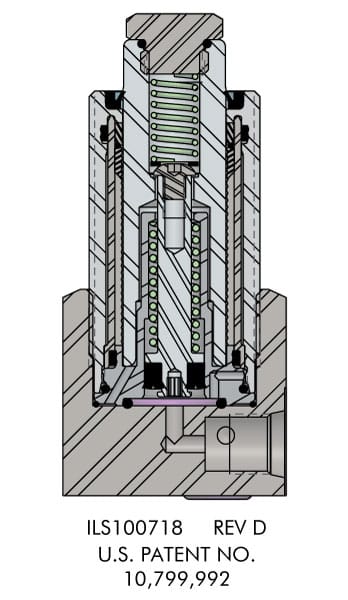
High Capacity Fluid Advance 4 Bolt Base
Cutaway

High Capacity Fluid Advance 3 Bolt Base
Cutaway

High Capacity Fluid Advance Part Present Sensing
Cutaway

Spring Advance Work Supports
Cutaway

Air Advance Work Supports
Cutaway

Fluid Advance Work Supports
Cutaway
Video
High Capacity Work Support
Training Video
Introducing the NEW World’s Smallest Work Support! Now up to 3X competitive capacity at 5,000 PSI! Plungers stay retracted during part loading. Hydraulic pressure advances the plunger exerting only spring force as it makes contact with the part. Hydraulic pressure then automatically sequences, freezing the plunger, to properly support the part.
FAQs
Browse our most Frequently asked Work Support questions and if you have an issue that isn’t covered here, reach out to our product support team below.
Why do I need to use work supports?
The basics of 3-2-1 fixturing require that three points define one plane of part location. When machining, a part ypu may need additional support for more than the three basic locators. A floating location support (work support) is an easy solution. You can use a work support anywhere a “screw jack” can be used. It adjusts faster, without dependence on the operator’s “feel.”
A work support will provide solid adjustable support for parts ranging from fragile circuit boards to massive airplane wing spars. They provide “automatic” adjustment and lock up giving repeatable, predictable results without the risk of “forgetting” a clamp or the time of manually adjusted alternatives.
What is required to use work supports?
Work supports will work in most applications where part distortion, chatter, ringing or poor surface finish results are present. They can eliminate or decrease most of the problems caused by part movement during machining. All you need to use them in an application is space to insert the support, a power supply and plumbing. They can work wonders to improve part quality and reduce scrap and rework. Work supports are often used on fixtures where parts are manually clamped but require additional support.
After the plunger is advanced, hydraulic pressure is used to “squeeze” the sleeve against the plunger, “locking” it securely against the part. It then becomes a solid support holding the part with the capacity indicated on the capacity chart.
Can I use work supports without other hydraulic clamps?
Yes, work supports are often used when only manual clamps are used. They reduce the dependence on “operator feel,” speed operations by locking multiples with a single adjustment and speed load time dramatically even when used with manual clamps to secure the part. In fact, one of Vektek’s most effective applications was one where the part was bolted in place over a tower equipped with several work supports. They supported the inside of a case while the outside was being machined. Our work supports reduced the part loading time from over five hours to just under one hour in this application.
Explain the difference in the three advance types and why I might want to use one over the other.
Spring advance is typically used when the part is heavy enough to depress the spring loaded plungers. This can be used on most applications.
Air advance is normally used when a part is very light, fragile or heavy contamination is present. Light weight parts may require clamping before the supports can be advanced. Air advance supports can be “fine tuned” to lightly touch the part without distorting or unseating it before lockup. When heavy contamination (fines, heavy flood coolant or corrosives) is present, use of a full time “air spring” continuously purges the sleeve/plunger contact area to keep it clear.
Fluid advance is recommended to avoid the introduction of a second power medium or when the plunger must be retracted to allow part loading. This is significant when palletizing fixtures where quick connectors must be connected to add an air control circuit to the fixture. Fluid advance supports should not be used if advance force control is required.
What is the "breather port" and can I plug it or use it for my hydraulic connection?
All spring advance work supports require the exchange of air and will work consistently when allowed to exchange air to and from atmosphere. Air advance work supports have no breather, but use a continuous air e stream to advance the plunger into position. Fluid advance work supports can come in either a 4,000 lb vented style (ventless on request) or ventless style 1,000 lb and 2,500 lb models. This ventless configuration avoids the exchange of dirty fluid through a vent which can then become plugged and restrict movement.
What type of part will typically need work supports? Are there any I should avoid?
Parts with thin webs, unusual shapes or unsupported structures that must be held within a plane are likely candidates for work supports. There are no parts to be avoided. Cast iron and aluminum parts produce large quantities of fines that can infiltrate cavities and reduce work support life (air advance should be considered for both).
What about deflection?
Deflection is a difficult topic to discuss relative to work supports. Let’s start with a support measured in its free state with “no load, not locked.” This will establish a “no load, no lock zero” point. When a support is pressurized, there is a small amount of growth. As it is loaded the support “deflects” back closer to the “no load, no lock zero.” As the support approaches full capacity it may deflect below the “no load, no lock zero” slightly. Other factors which may be more important include: the surface finish of the part where it is contacted, the shape and contact area of the end effector, the actual cutter or load force applied to the part, and the repeatability from part to part or lot to lot. For this reason, Vektek has chosen to publish only repeatability data on our work supports.
Can I lay my work support on its side?
Normally, yes. As long as you are not using a heavy end effector or unusually side loading your support, the physical orientation should not affect performance. If you have a question about a specific application, please give us a call.
I have an interrupted cut that is going to take place over the top of a work support. The forces involved are transmitted directly down on the support. The cutter is a large milling cutter and the cut is interrupted because I am sawing through webs on a cast part. How do I size the work support for this application?
You are correct that the impact of the re-entry of the teeth on the cutter to the next web of your part will create an interruption and mill may cause an impact beyond the normal “horsepower, depth of cut and tooth loading formulae.” In this case, you should plan to allow no less than 2X the calculated capacity. Impact loading from interrupted cuts can require increasing capacity beyond this safety measure, hence 5:1 times calculated force in the event of interrupted cuts may be appropriate. Keep in mind that if you are tapping with a ball peen hammer the upsizing is less than if you are impact loading with a full striking blow, but often both create forces well beyond the size of the hammer.
Do I need to use a torque wrench and socket when installing cartridge work supports?
Yes, a torque wrench and a 6 point socket is required. If you use an open end, adjustable or box end wrench you increase the chances of damaging the hex, roundness of the support sleeve or damaging the seals causing leakage between the sleeve and body. Please use an appropriate socket, torque wrench and care when installing cartridge work supports.