
Overview
A pneumatic swing clamp uses air pressure for clamp motion and is ideal when hydraulic power is not available.
- Arms swing 90°.
- Our capscrew arm design is available. You may modify our arm, or we have provided you with dimensions to make your own.
- Special wipers and swept-line cylinder tops help keep chips from packing and coolant contaminants from entering the swing clamp.
- Swing clamp bodies are wrought aluminum alloy with PHC™ (Pneumatic Hardcoat) coating on all external and internal surfaces. This gives the clamps extended life.
- Plungers are carbon steel with hard chrome plating. The guide bushings are hardened alloy steel.
- All dynamic seals are internally lubricated and made from a specially compounded elastomer to promote smooth break away and low operational drag.
- Six bore sizes are available in two mounting styles to best adapt to your application.
- All models are available in straight pull and left or right swings.
- Magnetic pistons are standard on all models, allowing you to use position indicating sensors.
- Position sensors mount within the clamp’s space envelope so sensor usage doesn’t encroach on the clamp’s mounting envelope.
- Position sensors have an LED indicator to reduce set-up time.
- All swing clamps have internal orifices to prevent cam damage caused from over accelerating the clamp.
- VektorAir™ clamps are double acting to reduce mounting envelope and prevent non-return and slow return problems inherent with single acting clamps.
- To determine whether a straight pull, left or right swing should be specified, imagine viewing the arm from above during the clamping stroke. Arms moving clockwise are right hand swings, counter-clockwise are left hand swings.

Cutaways
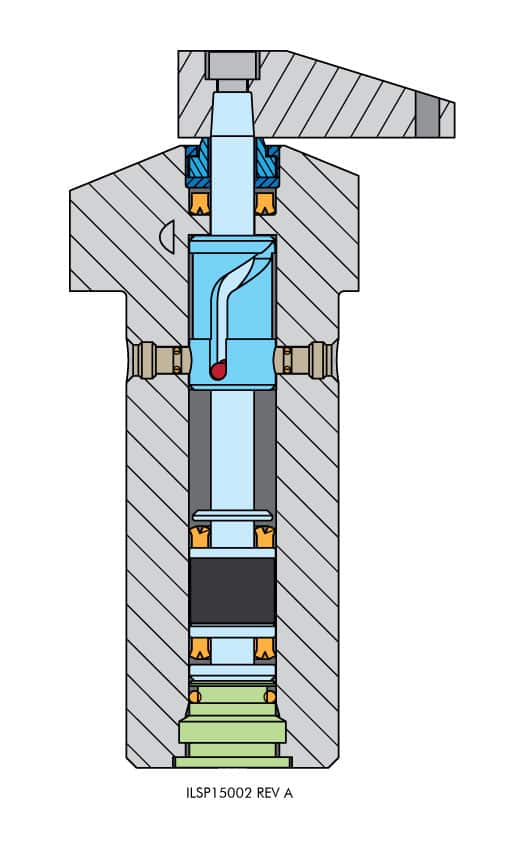
Top Flange Threaded Body
Cutaway
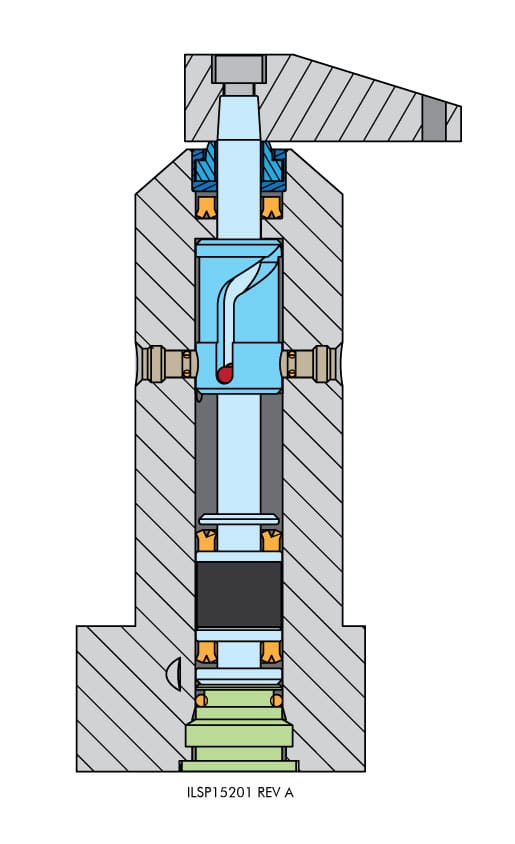
Bottom Flange Swing Clamp
Cutaway
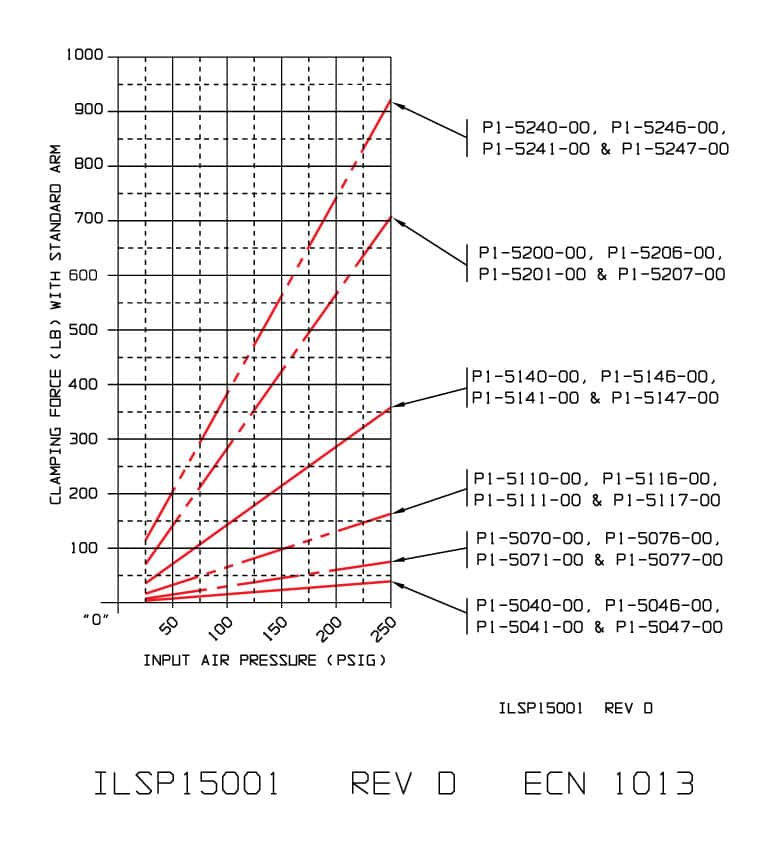
Clamping Forces
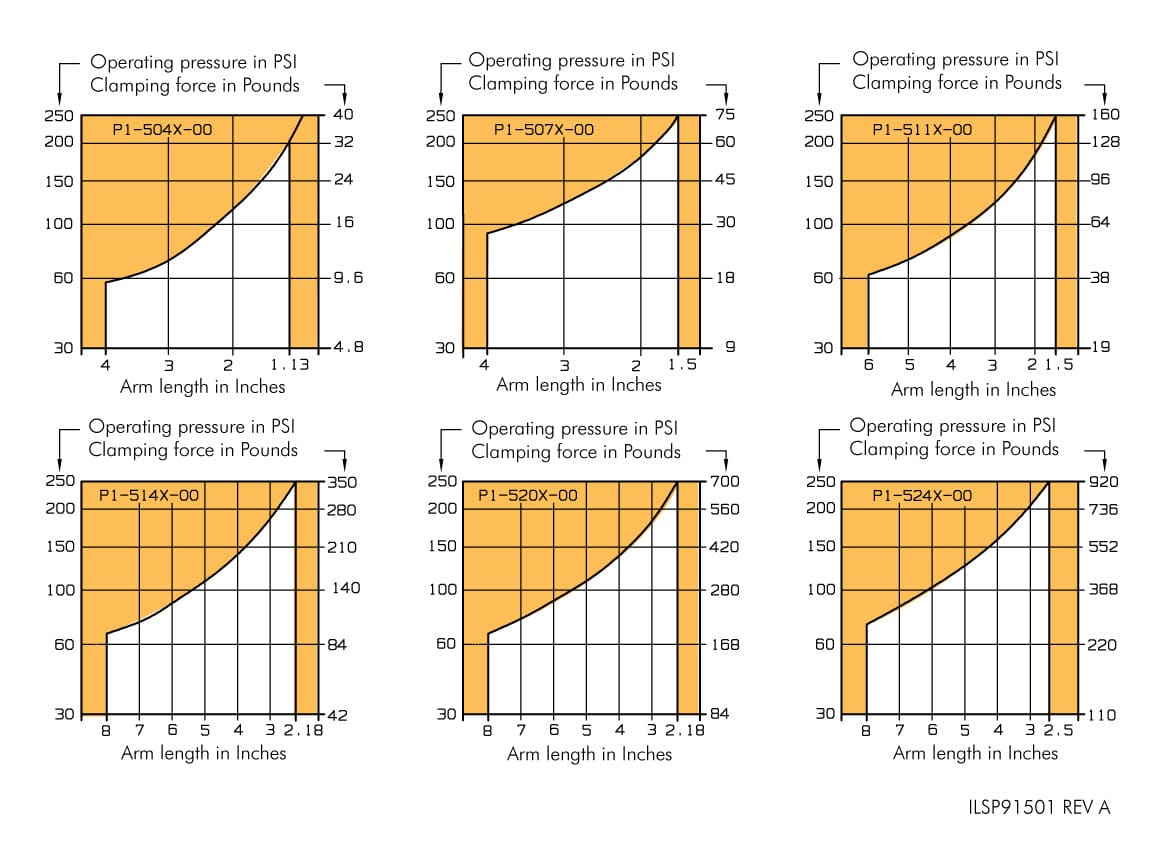
Arm Limits
FAQs
Browse our most frequently asked questions and if you have an issue that isn’t covered here, reach out to our product support team below.
Why do I need to know my shop air pressure when planning my system?
Your shop air pressure (in psig, pounds per square inch gauge) will help you determine the size clamp necessary to perform the work that you want to accomplish. The pressure should be measured with an accurate gauge at the point nearest the work area and with normal demand on your system. Pressure measured at the compressor is not valid because continuously pressurized gauges are notoriously inaccurate and there is measurable pressure drop over any extended length of pipe, hose or tubing. Demand on your system will result in fluctuations between just a few percent and as much as 50% for an undersized compressor. You will need to know the minimum air pressure supplied continuously to avoid having parts come unclamped or clamps not operating properly.
Is it necessary to check our clamping system for air leaks?
Yes. Since air used in a pneumatic system is a compressible medium, leakage will dramatically affect clamping loads. Therefore, circuits should be checked with a suitable leak detection solution such as SNOOP® or equivalent.*
*SNOOP® is a registered trademark of Swagelok®.
We shut the air supply down to our clamps once they are in position. Sometimes we notice that they are sticking. Could this be the cause?
Yes, you should avoid deadheading clamp circuits. Keep the valve engaged and air flow to the clamps during the entire clamping cycle.
After clamping, my swing clamps are moving. I cannot detect a leak. Why do I have this movement?
Where have you set your minimum operating pressure? When establishing operating pressure for the system, remember that 30 psig is the minimum and must be maintained during cycling. If you set your regulator to 30 psig and then open the valve and the pressure drops to 20 psig during clamping, you need to increase pressure until 30 psig is maintained during the entire clamping cycle. This will prevent cycle problems like the one you describe.
We need to regulate the speed of the clamping. How is this best done?
If component speed is an issue, always regulate the speed from the opposite side of the piston where the pressure is being applied. In other words, if the return stroke is to be controlled, use the exhaust flow from the extend stroke to regulate the speed. This will give superior control and avoid problems with devices sticking.
Is it necessary to use an intensifier?
No. You do not need an air intensifier to make your clamps work. Air intensifiers will allow smaller physical size clamps to do more work. For example, referring to the Product Clamping Forces chart, clamp P1-5110-00. will generate 165 lbs. clamp force at 250 psig, P1-5240-00. will generate 165 lbs. at 60 psig, but is over twice the bore diameter, jumps from 1 7/8″ to 3 1/4 in body thread and from about 5 1/2″ to over 8″ in height. If smaller is better, higher-pressure makes swing clamps smaller.
Can we restrict our swing clamps to rotate less than 90 degrees, or make them rotate further than 90 degrees?
Restricting the swing to less than 90 degrees is reasonably simple. We can provide 45 degrees and 60 degrees for a small up-charge. Precise swing angles and those greater than 90 degrees are possible as specials and will be costly. Contact your Vektek representative to discuss special swing clamp needs.
Can we modify the standard arm that is included with the swing clamp?
Yes, you may modify the standard arm; it is machineable and weldable steel. In order to remove it, please be sure to follow arm removal and re-installation instructions. Remember that larger arms are larger mass and reduced rotational speed is recommended to avoid damage to the rotational cam track.
Why would we use a sensor switch with our swing clamps?
You may choose to use a position sensor to detect the location of the swing clamp plunger. The sensors can confirm clamp in position, clamp in unclamp position or clamp in neither clamp or unclamp position.
You have questions? WE HAVE ANSWERS!
Use the contact button below to be connected with one of our team of experts.