
Overview
VersaCam Swing Clamps
- Large ball and cam rotational mechanism assures the swing action.
- VersaCam models swing 90°, swing angles of less than 90° readily available for a small additional charge. Swings of more than 90° are special order products
- The original duck billed, cross bolt locking, top cap screw arm design, as originated by Vektek, is highly recommended due to its low mass, versatility, and ease of modification.
- Special wipers and swept-line cylinder top prevents chips from packing and coolant contaminants from entering the operation.
- Vent port with bronze filter gives the cylinder a place to breathe and helps keep chips and coolants from sucking past wipers (Unclamp port on double-acting models)
- Exclusive BHC™ (Black Hard Coating) on the cylinder bodies and rod bearing surface helps prevent leaks caused by scoring and scratching especially in the event of high side or “kick” loads which promote excessive scoring in many other brands. BHC™ gives a Rockwell 60C skin hardness.
- Hardened Chrome alloy steel plungers run longer with less wear and drag than other brands.
- Proprietary seal designs reduce leakage and increase seal life for longer lasting, more dependable operations.
Vektek now offers the VektorAir™ line of pneumatic clamping devices and accessories, rated to run up to 250 psi. If you currently use our hydraulic models adapted for air, you may continue to do so, contact our sales office for air ordering information or a catalog.
Cutaways

VersaCam™ Threaded Body
Cutaway

VersaCam™ Threaded Body Long Stroke
Cutaway
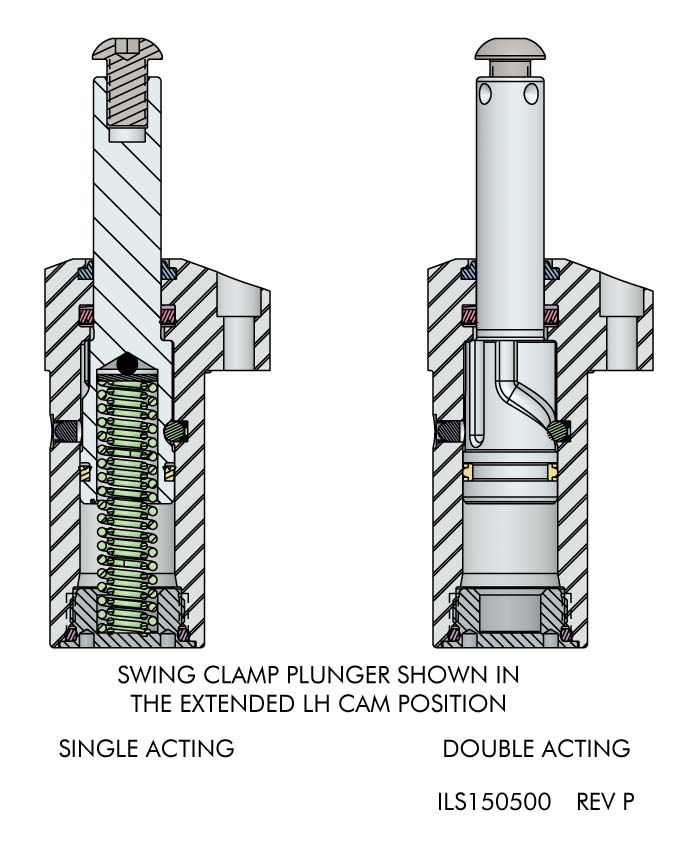
VersaCam™ Top Flange
Cutaway

VersaCam™ Bottom Flange Swing Clamp
Cutaway
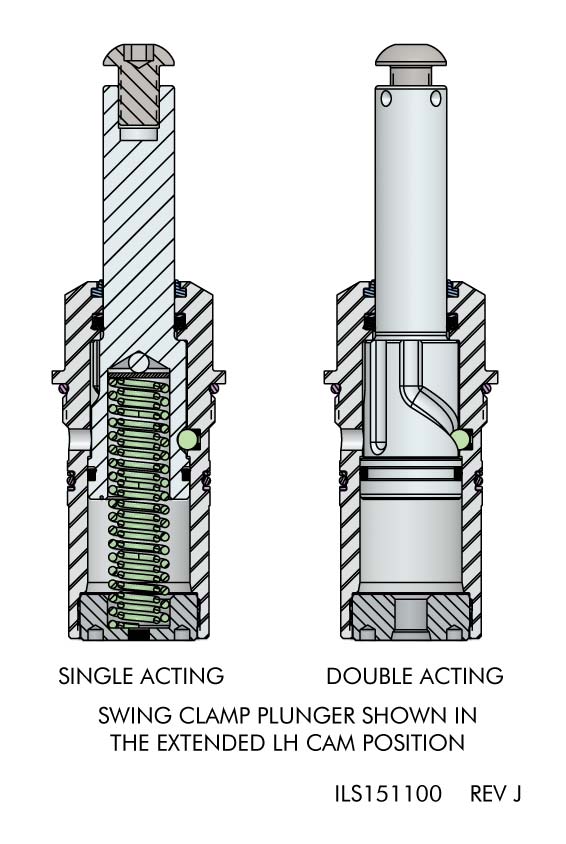
VersaCam™ Cartridge Mount Swing Clamp
Cutaway
Clamp Time and Fluid Flow Rates for VersaCam™ Swing Clamps
- The above flows are maximum recommendations and clamp times are minimum recommendations.
- For upreach and double arms, use extended arm flows and times.
- The actual time to position the clamp will vary by custom arm configuration and may require customer testing in specific application to establish limits.

Clocking
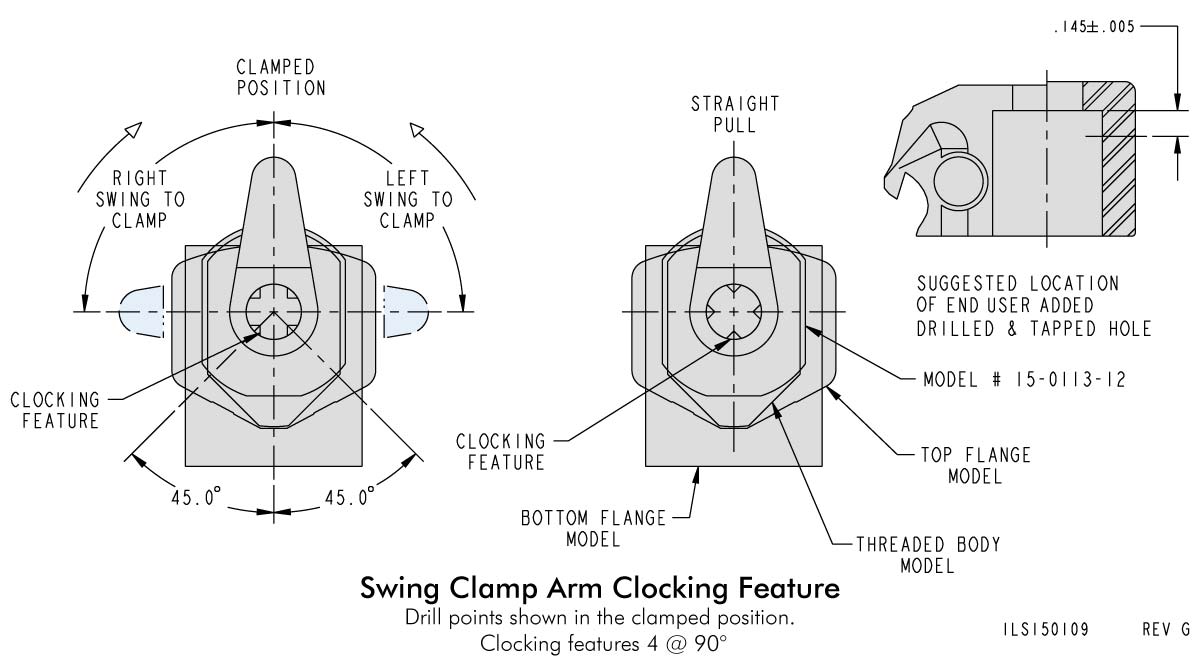
Swing Clamp Arm Clocking Feature
Machined on most Vektek swing clamps, the Arm Clocking feature will dramatically reduce the time it takes to change arms for maintenance, replacement or design set up. This innovation eliminates the need for expensive special swing clamps and moves cost effective user modifications to the clamp arms.
A drill point on each clamp standardizes arm location at a particular position. An additional three drill points reside 90° out from that position and each other. Access to the positioning feature is through the back or side of the arm, making modification a snap for users. Each arm position can have its own specification.
Restrictors
Swing Restrictors add just one more element of flexibility when using Vektek VersaCam™ Swing Clamps. Normally shipped with the swing angle set to 90º, you can have swing restrictors added to your clamps to limit the the arm swing to 30º, 45º or 60ºof rotation. Restrictors that are factory installed on new product will be specially marked to avoid intermingling clamps with varying swing angles in your shop. Contact your Vektek Customer Service specialist should you need swing angles greater than 90º.

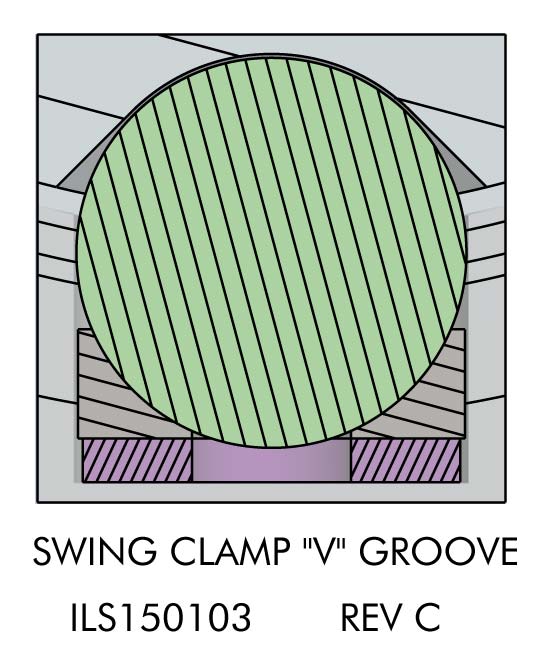
Patented V-groove cam design
- V shaped design provides a tougher mechanism. The ball runs deep in the track eliminating cam to ball edge loading.
- Resists flow related damage better than our previous design (Please follow recommended flow rates for longest swing clamp life).
- Lasts longer and will withstand operator induced crashes from improperly loaded parts with less damage.
- Provides planar rather than edge contact with the cam follower.
- Will withstand swing interference better than other cam designs.
- External cam swing clamp models (all standard swing clamps except High Capacity, Low Profile) have hardened V-cam tracks that resist damage and give you a built in extra cam (opposite swing direction) or straight line option should you accidentally damage one. Specify left, right or straight cam and we will preset the swing when you order.
- Internal cam swing clamps (High Capacity, Low Profile models) have double V-cams providing extra strength, but must be ordered in the required swing direction. Low profile 5,000 and 7,500 lb. swing clamps do not have built in multiple direction cams.
- Vektek again changes the state of the art in ball and cam swing clamps making them work better at reasonable prices.
FAQs
Browse our most Frequently asked questions and if you have an issue that isn’t covered here, reach out to our product support team below.
Where and when should I use VersaCam™ Swing Clamps?
VersaCam™ Swing clamps are a logical choice where loading of the part is hampered by other styles of clamp. Swing clamps (as their names indicate) move out of the way for easy access to the load/unload area. They may be easily visualized by tool designers and the action emulates that of manual strap clamps, which have been used for years.
Are there some applications where I need to avoid using swing clamps?
Yes, swing clamps should not be used without fixed stops or hard locators into which the cutter force is transmitted. If swing clamps are oriented to hold vertically, horizontal cutter forces should be transmitted into solid stops that can easily absorb their energy. If forces are transmitted to swing clamps at 90° to the clamp action, all of the force is transmitted into the rotating mechanism. This may result in premature wear and early failure.
How do I size swing clamps?
First, calculate your cutter forces to be resisted. Then examine the direction of these forces. Determine how much of these forces will have to be held by the clamp. Size your clamp based on the estimated working pressure of your fixture. (We recommend using 3,000-4,000 psi at this point to give you some additional capacity if required when your fixture is complete or processes change.)
I want the fastest possible action from my swing clamps. How do I do that and how fast can I get?
Look at the Clamp Time and Fluid Flow Rates chart to determine flow rates. If you are unable to determine flow rates, use the time limitations indicated under the same footnote. A good rule-of-thumb, “If you see the clamp open, then see it closed, but don’t see it move between, it moved in less than 1/16th second. That is always too fast.” Finally, ask yourself; “To what good use will the operator put that extra fraction of a second?” If the answer is none, slow the clamp down.
I am planning to exceed the flow rating of your clamps, but I will be using low pressure (750 psi). That's OK isn't it?
No. Excessive speed is excessive speed, regardless of pressure. Swinging an arm against a cam faster than intended is not recommended. It will shorten clamp life even at low pressures. We recommend not exceeding maximum flow rates. The flow control swing clamp may be your solution.
My swing clamps don't all contact the part at the same time. Why?
Flow restrictions, excess fittings, long tubing runs and different springs can all cause swing clamps to swing at different times. Despite the appearance, they actually build to pressure at approximately the same time. Because some customers (often the machine operators) are sensitive to the timing of their swing clamps we created the flow control swing clamp. Look to this clamp as a solution to the timing sensitive problem or add your own flow control valve at each swing clamp.
NOTE: Do NOT use this as a sequence valve.
I want to run my swing clamp on air; is this easily done?
We have designed pneumatic swing clamps. It can be done for the three larger sizes of hydraulic swing clamps (excludes Low Profile models). The smallest swing clamp may not be changed to air. It is extremely difficult to control air flow into or out of a pressure vessel this small. We do not recommend that the smallest clamp be converted to air, nor will we warrant its use in this application. Please call us for specific ordering details.
My application calls for an arm about the size of a baseball bat. It only weighs 14 lb. How fast can I swing it?
VERY SLOWLY! Weight, like flow, can damage a swing clamp. If you must use an arm exceeding the weight of our standard or extended arm, slow it down. Heavy arms should be used on double acting clamps only, and swing speed must be restricted in both directions. Remember the Arm Length and Pressure Limitations from the charts provided.
I want to use a 450 lb. swing clamp but need a 5,000 lb. swing clamp arm for length. How do I fit this arm onto the clamp? What are my flow and pressure restrictions?
You will have to add to an extended arm or make a custom. We cannot supply an arm modified to these specifications. A reach of this distance is not recommended. If you must reach beyond the limits charted, please consult Vektek’s engineers.
I need to clamp over a work support. Are there any special precautions that I should take?
Yes, you will want to be sure that the clamp is sequenced to swing only after the support has built sufficient pressure to hold the force it is capable of generating and that they are properly sized. Sequencing is recommended only above 2,000 psi using a Vektek sequence valve (other brands will not work). The recommended swing clamp to work support ratio is approximately 1:2 (1,100 lb. swing clamp, 2,500 lb. work support).
My part won't take 5,000 psi. How do I make your clamps work?
Your part doesn’t have to take 5,000 psi. The force exerted on your part is determined by the pressure (in psi) times the piston area (in sq. in.). The force exerted by VektorFlo® swing clamps ranges from 450 to 5,000 lbs. at 5,000 psi input pressure. If you adjust the pressure down to 2,500 psi, your force will range from 225 to 2,500 lbs. depending on the model selected. You can generally adjust your pressure from 750 to 5,000 psi and get just the force you need to hold your part properly.